

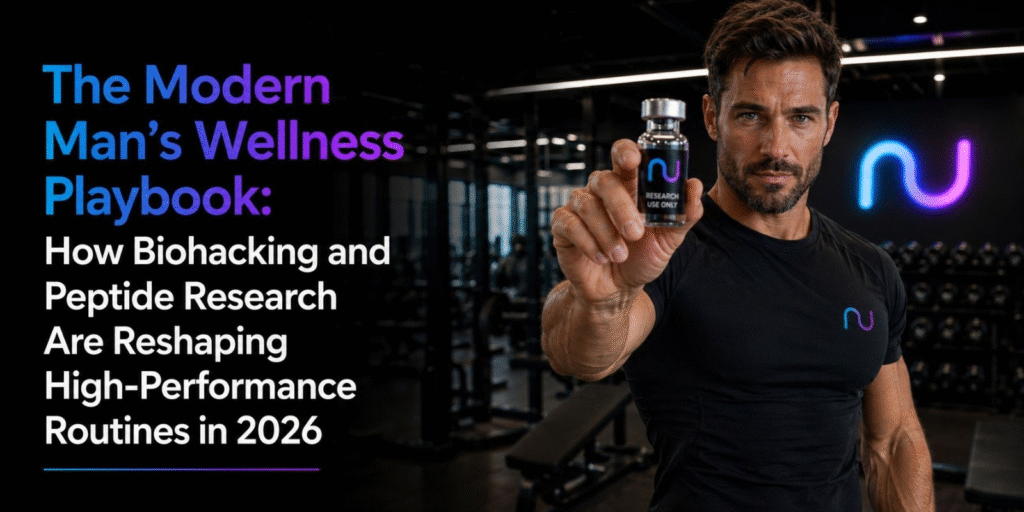
Ask any successful entrepreneur, founder, or executive what their day looks like in 2026, and you will hear a version of the same answer. There is a wearable on the wrist. There is a glucose monitor on the arm. There is a sleep score on the phone. There is a supplement stack on the counter, and increasingly, there is a conversation about peptide research happening in the background of that stack.
This is not the wellness world that existed ten years ago. The shift has been quiet but enormous, and it has reshaped what high-performance living looks like for the modern man. This piece is a look at the playbook, the cultural forces behind it, and where the conversation is heading next.
From Lifestyle Magazine to Operating Manual
For most of the last century, men’s wellness was about appearance. Build the body. Cut the fat. Look the part. The new wave is about function. How well does the body recover? How stable is energy across the day? How sharp is focus by hour seven of deep work? How resilient is sleep across travel?
Biographies of successful founders and executives often reveal the same pattern. The morning routine is no longer optional or aesthetic. It is operational. Cold exposure, breathwork, training, structured caffeine timing, and protocol-driven nutrition are tools, not trends.
The Three Pillars That Define the New Playbook
Sleep as a Performance Asset
Modern wellness culture has elevated sleep from background necessity to central asset. Most high-performance routines start with sleep as the non-negotiable, because nothing else compounds without it. Sleep tracking has become normal rather than fringe, and the conversation has moved from quantity to architecture. Deep sleep percentage, REM duration, and resting heart rate trends are watched in the same way runners once watched mile times.
Metabolic Awareness
The continuous glucose monitor has become one of the most quietly transformative tools in this category. Once a device for people managing diabetes, it now lives on the arms of executives, entrepreneurs, and athletes who want a real-time window into how food, stress, and movement affect their blood sugar. The data shifts behaviour faster than any nutrition book ever did. People discover within a week that their reliable afternoon crash has a perfectly explainable cause.
Recovery as the New Edge
Training hard is normal. Recovering well is rare. The third pillar of the modern playbook is the science of repair. Sauna, cold exposure, structured rest days, soft tissue work, mobility, and increasingly, the conversation about research compounds aimed at tissue repair have all flowed into this category. This is where peptide research has entered the mainstream wellness vocabulary.
Why Peptide Research Became Part of the Conversation
Peptide research is not a new field. What is new is the cultural moment. Podcasts have brought obscure molecules out of laboratories and into the everyday conversations of executives and lifestyle enthusiasts. Names like BPC-157, TB-500, GHK-Cu, and Semaglutide-class compounds are now familiar to a far wider audience than ever before.
Some of this attention is unhelpful and oversimplified. But some of it reflects genuine curiosity about a category of molecules that have been quietly studied for decades. The modern high performer wants to understand what the science actually shows, what is still being explored, and what is real versus oversold.
It is important to be clear. Peptides sold as research compounds are not human medicines. They are laboratory materials with literature behind them, and the conversation around them is best treated with the same intellectual honesty as any other research topic.
The Lifestyle Beneath the Data
The biographies of the men who have leaned into this culture share a few common threads. Most of them are not chasing extremes. They are chasing consistency. They want to be present for their families on a Tuesday evening. They want to perform on a Thursday board call. They want to be able to sprint with their kids on a Saturday without a recovery cost that lasts into Monday.
The wellness playbook is, in the end, a tool for life logistics. It is about being usable across decades, not just dominant for one season. That framing tends to shift the conversation away from gimmicks and toward what actually works over years.
Where to Be Sceptical
This category attracts noise. Anyone reading about modern wellness in 2026 will encounter overconfident claims, dramatic before-and-after stories, and influencers selling products with no analytical backing. The first filter for any modern wellness consumer is simple. Where is the data, and who verified it?
This applies especially to research compounds. Reputable suppliers in this space publish third-party Certificates of Analysis from independent laboratories such as Janoshik Analytical. Purity is reported as HPLC percentage, typically at or above 98 percent. Lot numbers are documented. If any of that is missing, the product is not research-grade, regardless of how the website looks.
This is where companies that take quality seriously, such as New-U Research Compounds, have started raising the floor for the category. Transparent batch documentation has become the new baseline for legitimacy.
The Bigger Picture
The modern man’s wellness playbook is not really about peptides, wearables, or any single tool. It is about the underlying mindset. The mindset that a body is a long-term system, that data is more useful than dogma, that recovery is as serious as training, and that decisions made in your thirties and forties compound far further than most men once realised.
That mindset is the actual playbook. Everything else is just the toolkit, and the toolkit will keep evolving.
Frequently Asked Questions
What is biohacking, really?
At its simplest, biohacking is using data and structured experiments to improve physical and cognitive function. The toolkit has expanded over the years from basic supplements and sleep tracking to include continuous glucose monitors, HRV tracking, and ongoing interest in research compounds. The principle has not changed. Measure, adjust, repeat.
Is peptide research safe to explore?
Peptide research as a topic is fine to read about. Peptide research compounds are sold for laboratory use only and are not approved for human therapeutic use in major regulatory regions. The literacy that matters is understanding what the published science says and what it does not.
Do successful entrepreneurs actually follow these routines, or is it marketing?
Both. Some founders genuinely live the routines they describe. Others promote them as part of a personal brand. The signal worth following is the underlying logic, not the personality. Sleep, recovery, metabolic awareness, and intentional training are not trends. They are repeatable systems.
Where should a newcomer start?
Sleep. Always sleep. Until that is stable, nothing else compounds. Then nutrition, then training, then recovery, then advanced tools. Most people skip the boring parts and chase the exotic, which is exactly why most people stall.
Final Thoughts
The men reshaping wellness culture in 2026 are not the loudest voices. They are the quiet operators in their thirties and forties who treat their body the same way they treat their business. With data, with patience, and with a long horizon. The playbook will keep evolving, but the underlying discipline is the part that lasts.
Disclaimer: This article is for informational and educational purposes only. References to peptide research compounds describe materials sold for laboratory use only and are not intended for diagnosis, treatment, cure, or prevention of any disease.