

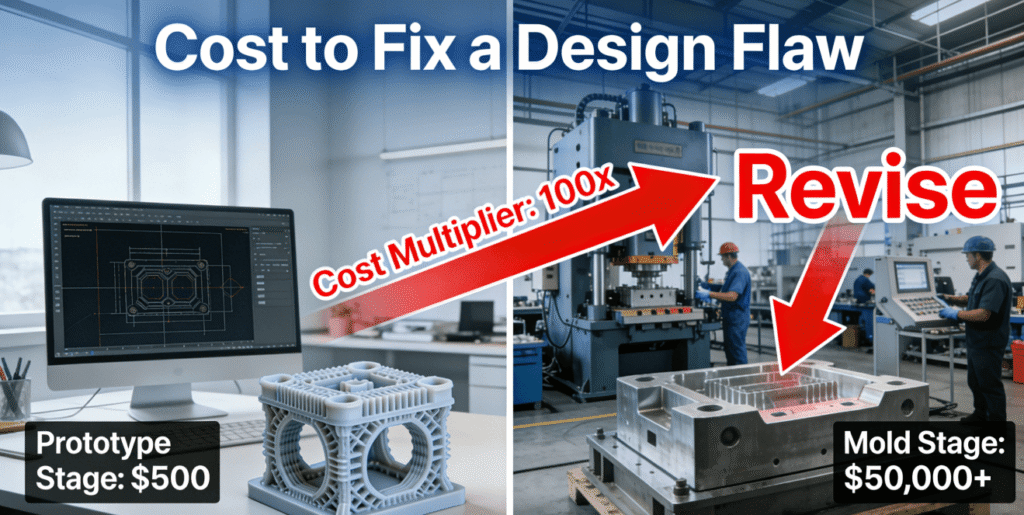
In product development, many teams face a brutal reality: minor design flaws undetected during the design phase can lead to catastrophic cost overruns and project delays in tooling and mass production. A dimensional error costing a few hundred dollars to fix in the prototyping stage can see correction costs skyrocket a hundredfold during mold modification.
The root cause of this problem lies in the disconnect between design validation and mass production processes. The traditional linear “design-then-tool” workflow lacks a crucial manufacturing prototypes phase capable of realistically simulating production conditions for comprehensive engineering validation.
This article delves into the professional industrial prototyping process, explaining how systematic prototype engineering identifies and resolves structural, material, and process feasibility issues before design freeze, thereby building a reliable bridge connecting concept and mass production. Achieving this goal hinges on understanding the following five core dimensions.
Why is Professional Industrial Prototyping Key to Controlling Total Project Cost?
Industry data starkly illustrates the cost multiplier of late-stage changes: a flaw costing 500torectifyinprototypingcanexceed50,000 to fix in production tooling. This underscores the unparalleled economic value of front-loaded verification.
More Than a Model: A Systemic Engineering Discipline
Industrial prototyping goes beyond mere model creation. It is an entire branch of engineering that involves verifying functionality, reliability, manufacturing processes, and assembly processes. The key purpose of a manufacturing prototype is to mimic production environment conditions, hence the importance of its testing results in production. To systematically understand how prototypes cover the complete journey from concept to production, one can refer to this Comprehensive Guide to Industrial Prototyping.
- Fidelity in Material and Performance
Professional Precision Manufacturing Services ensure the prototype matches the final product in material grade, mechanical properties, and dimensional accuracy. For instance, CNC machining a part from the exact aluminum alloy or engineering plastic specified for production yields strength and thermal data with high reference value.
- Avoiding the “Prototype Mirage”
Significant discrepancies in precision, finish, or material between the prototype and the production part can lead to misleading test results—a “prototype mirage”—allowing hidden defects to enter mass production with severe consequences.
The Cost Logic of Risk Forward-Loading
Thorough validation in the prototyping phase can identify and resolve up to 80% of design and process issues upfront. This initial investment is essentially “insurance” purchased against the high costs of late-stage tooling changes and production instability, representing the most critical lever for controlling total project cost.
What Core Validations Should a Qualified Manufacturing Prototype Fulfill?
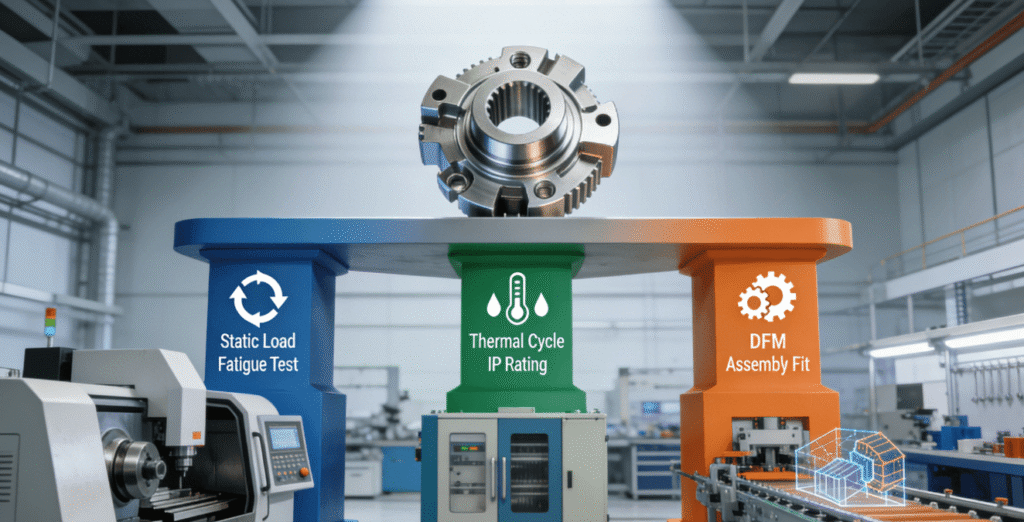
The value of a qualified manufacturing prototype is realized through systematic prototype engineering validation. This typically rests on three core pillars, emphasizing early engagement in manufacturing and prototyping collaboration.
Structural validation is foundational. It encompasses static loading, fatigue, and impact testing to ensure that the product is able to sustain the mechanical forces that will be applied during its life cycle. Destructive testing of a prototype produced through CNC machining gives a realistic representation of the material’s yield and fracture point, helping make the correct safety factor decisions.
Environmental verification is essential for ensuring that products function in their operating environments. It is important that products are able to perform under their designated operating conditions. This necessitates that prototypes be tested for thermal cycling, corrosion, UV aging, and ingress protection (IP).
Manufacturability validation bridges to production.This forms the essence of design and prototyping collaborations. The team needs to undertake detailed Design for Manufacturing (DFM) exercises as part of the process of designing. This involves optimization of part splitting, draft angles, uniformity of wall thicknesses, assembling order, and tolerance stacking. Assembly tests involving prototype components could be undertaken physically to highlight possible interference problems in the production line.Validation itself is hierarchical, progressing from a “proof-of-structure” prototype to a near-final “engineering prototype,” with the ultimate goal of producing units suitable for low-volume pilot runs, customer samples, or regulatory certification.
Facing Complex Requirements, How to Choose the Most Effective Rapid Prototyping Tools?
With different validation requirements, there is no perfect rapid prototyping tools process that can be used. The right process should depend on the validation requirement, which will involve accuracy, strength, speed, cost, and material fidelity considerations.
CNC machining is the best choice for precise and accurate validation. This method is suitable for metals and engineering plastics, and it provides mechanical properties and surface finish similar to the final production component. As such, CNC machining is the ideal process for functional, life cycle, and mold validation. Rapid prototyping additive manufacturing, which is also known as industrial 3D printing, has no equal when it comes to producing complex shapes. It is the most efficient process for producing parts with internal passages, lattice structures, or monolithic assemblies.
When small numbers (tens to hundreds) of multi-material components are required for testing purposes, vacuum casting is very cost-effective. The process requires the use of a master pattern, which can be made using 3D printing or CNC machining, to create urethane parts.
The value of a professional service provider is that it will advise on “hybrid solutions.” For instance, a primary structural element could be CNC milled for durability, whereas complicated internal elements would be manufactured through 3D printing, with professional finishing to create uniformity. In choosing an ideal partner, certifications such as ISO 9001 and IATF 16949 are reliable signs of process reliability and consistency in prototypes.
How Does the Prototyping Phase Pave the Way for Smooth Mass Production?
The prototyping stage is valuable not only because it results in a testable component, but also because it creates a valuable “data asset” that guides mass production. This demonstrates the deeper meaning of manufacturing and prototyping collaboration and serves as a foundation for efficient Customized Production Solutions.
The important data collected during prototype testing is invaluable. For instance, multiple injection mold prototype trials can determine the exact shrinkage rate for a given material and wall thickness, which in turn allows for accurate mold design compensation. The most favorable gate location, cooling channel layout, and ejection method are determined from observations made on prototype molds. For assembly, the validated optimal tolerance fits and jig design can be used to create work instructions and inspection standards for the production line, thereby reducing pilot-run debugging time and cost.
Effective prototyping and production collaboration requires that the people responsible for creating prototypes and those responsible for designing the manufacturing process talk extensively right from the beginning of the project. The engineers who create prototypes are familiar with production capabilities, whereas the production engineers take the insights provided by prototypes into consideration. This seamless transfer of knowledge and experience ensures a smooth transition from “designable” to “manufacturable, assemblable, and testable,” truly eliminating obstacles to mass production.
What are the Common Success Factors in Successful Industrial Prototyping Projects?
After looking at many Industry Success Stories, it is clear that there is a specific recipe for success when it comes to creating successful prototypes.
Defined Objectives and Robust Processes
Firstly, the key validation objectives should be identified right from the start of the project. Secondly, there should be an insistence on materials and processes that will be identical or extremely close to mass production process. The latter can only be provided by a company which provides true Precision Manufacturing Services.
- Engineering Skills Above Equipment Ownership
Working with a service provider that demonstrates profound engineering skills early on in the prototype development stage is a must. They should provide DFM analysis services, not merely “make to print” type of support. Good prototype engineer is always a good expert on manufacturability issues.
- Certifications as a Capability Indicator
In case of industries like aerospace, automotive, and medtech, relevant industry certifications (AS9100D, IATF 16949, ISO 13485, etc.) serve as the best evidence of robustness of engineering capabilities and QMS.
Data-Driven Decisions and a Holistic Cost View
Prototyping should provide comprehensive reports from inspections (dimensional, material certification, FAIR) that will help make data-based design freeze decisions. Proper management of the prototyping budget is extremely important for achieving balance in the entire project budget. Special strategies could be considered in more depth in the following An In-Depth Analysis of Cost Control in CNC Rapid Prototyping. A typical success story would be as follows: “Company X saved over $20,000 and gained 6 weeks by validating the prototype and detecting a critical problem.
Conclusion
Industrial prototyping is not simply sample items; they are important strategic investments. The strategic validation through proactive engineering helps address the uncertainties and costly risks of mass production in an early stage in the design process. Gaining complete control over the process – prototype engineering, manufacturing and prototyping collaboration – is the key factor for achieving the best results in terms of time, quality, and cost efficiency.
If your next product design encounters manufacturing issues, time constraints, or other problems related to performance, start consultations about a proper approach to product prototyping with a qualified manufacturing partner JS Precision, and see your design brought to life.
Author Bio
The above information was obtained from an expert in the field of manufacturing with over 15 years of practical experience.
FAQs
Q1: What is the main benefit of industrial prototyping?
A: Main benefit lies in risk forward loading and cost efficiency. Prototyping infinitely close to production intent to perform comprehensive tests prior to the manufacturing tooling ensures identification and elimination of approximately 80% of design and process-related problems which could cause major cost and time overruns down the road.
Q2: What is better – to choose CNC machining or 3D printing for my prototype?
A: Depends on the type of validation needed. CNC machining suits best for highly accurate and reliable testing in terms of function and material properties. 3D printing is a good choice when the need for highly accurate geometry is not required but fast iterations are necessary. In case when parts have intricate geometry, then it would be best to combine both technologies in one process.
Q3: How precise could be a prototype?
A: This all depends on the technology used. Using high-accuracy CNC machining, we can provide tolerances up to ±0.02mm which should be enough for assembly and functional purposes for any type of product. 3D printing technology has a relatively low level of precision, about ±0.1 – ±0.2mm which would be enough for validation at an initial stage.
Q4: Can the material for a prototype be the same as the one in final manufacturing?
A: Yes indeed, and this is what professional prototyping is all about. In CNC machining and injection molding prototypes, the actual metals or plastics that will be used in mass production can be used, ensuring accurate information for mechanical testing, thermal testing, etc.
Q5: How can the development costs be controlled during prototyping?
A: By clearly specifying validation objectives to prevent overengineering; working closely with the prototyping service provider on DFM; combining multiple components into a single quote; and giving an appropriate lead time. A detailed cost composition and control strategy calls for professional examination.